توضیحات
| مشخصات فنی | |
|---|---|
| مدل | GR1700 |
| Drum Capacity | 1,700 L |
| Production Capacity | 800–1,000 kg / batch |
| Vacuum Level | −0.08 MPa (negative pressure) |
| Drum Speed | 6–12 r/min (stepless, forward & reverse) |
| موتور اصلی | 2.2 kW |
| پمپ خلاء | ۳ کیلووات |
| قدرت کل | 5.2 kW |
| Recipe Memory | 100 programmes |
| Dimension (L × W × H) | 3,000 × 1,630 × 2,300 mm |
| وزن دستگاه | 1,300 kg |
| ساخت و ساز | SUS304 stainless steel drum and frame |
| کنترل | Digital PLC; vacuum breathing mode programmable |
| گارانتی | 1 year whole-machine |
1700L Vacuum Tumbler Machine for Meat Marinating — GR1700
The GR1700 is a 1,700-litre vacuum tumbler designed for industrial whole-muscle meat marinating at 800–1,000 kg per batch. Operating under −0.08 MPa negative pressure, it produces deep, uniform marinade penetration in intact cuts — ham, shoulder, loin, chicken thigh and breast, beef roasting joints — that cannot be achieved by static soaking or surface-application methods at commercially viable production speeds. The result is consistent product texture, improved cooking yield through enhanced water-holding capacity, and reduced processing time compared with conventional marinating methods.
The GR1700’s 100-programme recipe memory stores and recalls drum speed, tumbling time, rest time (breathing mode), vacuum level, and drum direction settings for each product in the plant’s range, ensuring that every batch of a given product receives exactly the same treatment regardless of the operator on shift. Stepless drum speed control from 6 to 12 r/min allows the programme to set the optimal tumbling intensity for product size, cut type, and desired end texture.
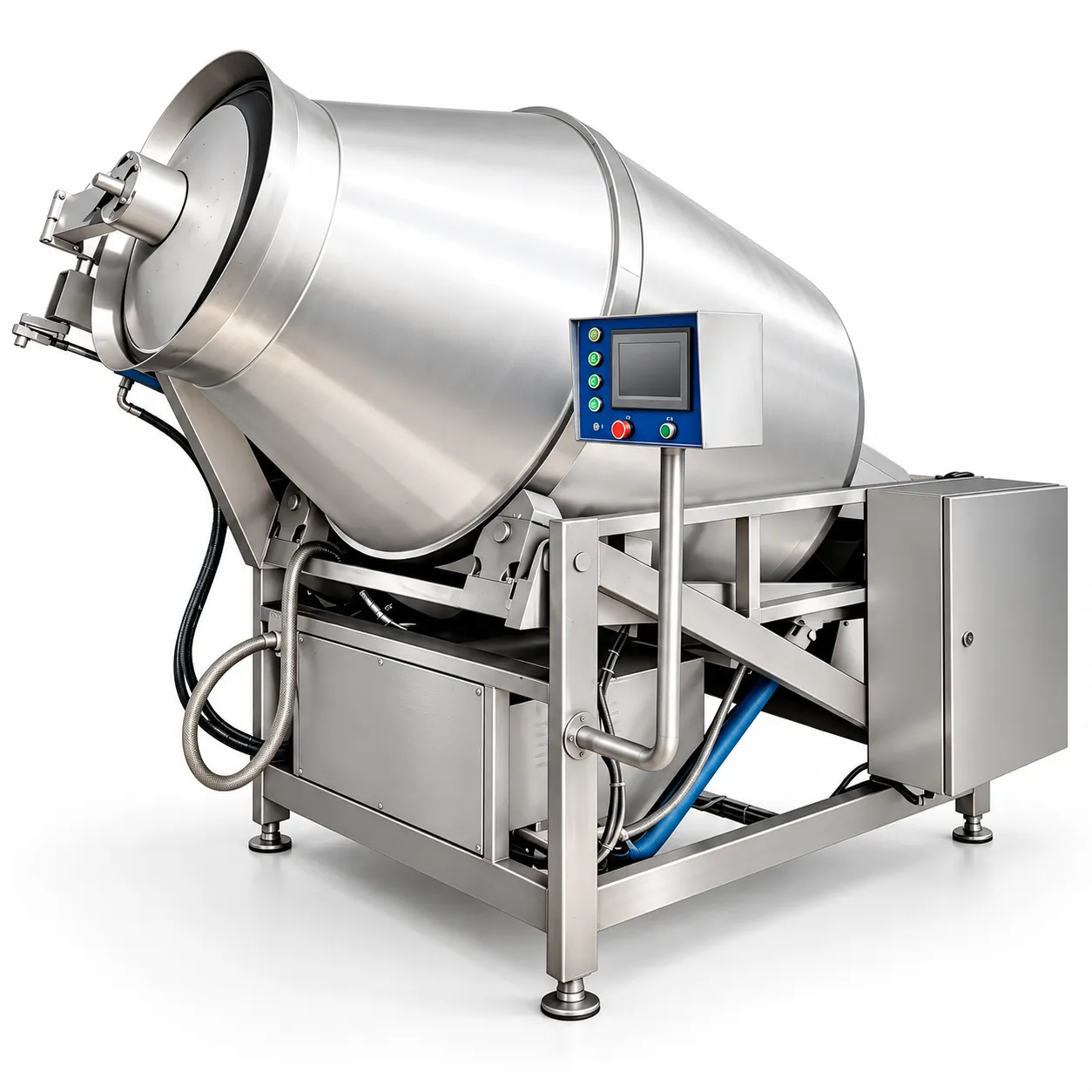
GR1700 — 1,700 L drum, 800–1,000 kg/batch, digital PLC control
Vacuum Tumbling vs. Static Marinating: The Technical Case
In static marinating, brine penetrates intact muscle by diffusion. Diffusion is a slow process: in typical pork or chicken at 4 °C, achieving even partial penetration to the geometric centre of a 50–80 mm cut requires 24–48 hours of soak time. Even after this extended period, the brine concentration gradient from surface to centre is rarely uniform, producing inconsistent flavour, colour, and texture across the cross-section of the finished product.
Vacuum tumbling replaces diffusion-dominated penetration with a mechanical-assisted process. Under −0.08 MPa vacuum, the partial pressure inside the muscle fibres is reduced, causing the cell structure to open and allowing marinade to be actively drawn into the tissue as the drum tumbles. Simultaneously, the physical tumbling action massages the product against the drum wall and internal baffles, disrupting the surface layer and continuously presenting fresh, unmarinated interior to the brine. The combination of vacuum and mechanical action reduces penetration time from 24–48 hours to typically 2–6 hours, depending on product type, cut dimensions, and brine formulation.
Breathing Mode: The Vacuum Cycling Advantage
The GR1700 supports programmable vacuum breathing mode, in which the drum alternates between vacuum (negative pressure) and atmospheric pressure in programmable cycles during the tumbling programme. During the vacuum phase, muscle fibres open and marinade is drawn in; when pressure is restored to atmospheric during the rest phase, the muscle contracts slightly around the absorbed brine, mechanically fixing the absorbed liquid inside the tissue. This pulsed vacuum approach typically achieves greater total marinade uptake than continuous vacuum tumbling alone, and produces more uniform distribution through the cross-section of the cut.
Breathing mode is particularly effective for thicker cuts where the diffusion gradient between surface and centre is most pronounced: hams, whole shoulders, boneless legs, and full chicken breasts all show measurable uptake improvement with optimised breathing programmes compared with continuous-vacuum tumbling. The 100-programme recipe memory allows separate breathing-mode profiles to be stored and recalled for each product without manual parameter entry at the start of each batch.
- Breathing mode: programmable vacuum/atmosphere cycles for maximum brine uptake
- Penetration depth: 2–6 hours vs. 24–48 hours static soak for comparable penetration
- Vacuum: −0.08 MPa maintained by dedicated 3 kW vacuum pump
- Drum direction: forward and reverse programmable to prevent product accumulation
- Stepless speed: 6–12 r/min adjustable within programme for product fragility

GR1700 digital PLC — 100 recipe slots, breathing-mode vacuum cycle control
Cooking Yield Improvement and Commercial Value
The commercial value of vacuum tumbling is measured most directly in cooking yield: the weight of cooked product as a percentage of raw input weight. By improving water-holding capacity in the muscle through better protein extraction and brine distribution, vacuum-tumbled product retains more moisture during cooking than statically marinated or un-marinated control product. A cooking yield improvement of 2–5% — typical for optimised vacuum-tumbled vs. static-soak product in published industry studies — represents a significant reduction in raw material cost per kilogram of finished product.
For a plant processing 800 kg batches of ham or chicken breast per day, a 3% cooking yield improvement means approximately 24 kg of additional finished product from the same raw material input per batch. At commercial deli or food service prices, this value accumulates rapidly across production shifts. The GR1700’s 1,700-litre drum and 800–1,000 kg batch capacity are sized to deliver this benefit at industrial production volumes. The payback period for the machine investment can typically be calculated against the yield improvement and processing time reduction with the plant’s own production cost figures.
Drum Design and Product Handling
The GR1700’s drum is manufactured from SUS304 stainless steel with a continuous-baffle interior that lifts and folds the product as the drum rotates, rather than simply rolling it. The baffle geometry is designed to ensure every piece in the batch passes through the maximum-agitation zone on each revolution without piling up or crushing at the drum end. Product damage in vacuum tumblers is typically caused by excessive drum speed or inadequate baffling that allows heavy loads to accumulate and impact the drum wall; the GR1700’s stepless 6–12 r/min speed control and baffle design minimise surface damage even at full 1,000 kg batch weight.
The drum entry port is sized for easy product loading from standard 200-litre meat carts, and the drum can be positioned for gravity-assisted unloading. The vacuum port and seal are designed for single-person connection without tools, and the vacuum gauge is visible from the operating position. All seals, gaskets, and internal baffle surfaces are in SUS304 or food-grade elastomer to ensure compatibility with acid marinades, phosphate brines, and high-salt applications.
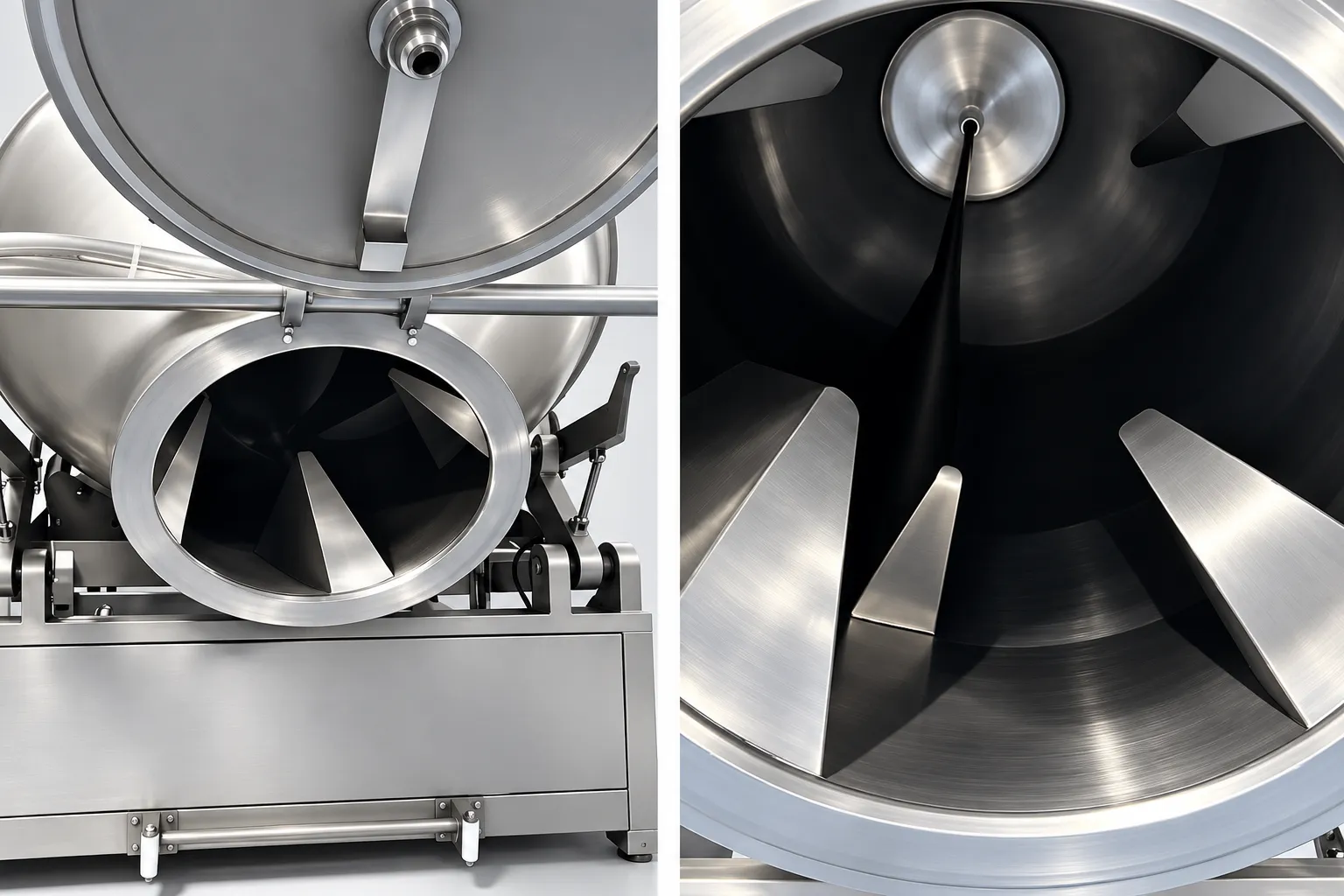
GR1700 drum interior — continuous-baffle SUS304 design, vacuum port detail
Processing Applications and Brine Integration
The GR1700 is used for whole-muscle pork, beef, chicken, turkey, lamb, and fish marinating for a range of processed-meat and food service applications: retail-pack marinated chicken, ready-to-cook seasoned pork loin, sliced deli ham, formed poultry roll, and brine-injected roasting joints for food service. The vacuum tumbler is positioned downstream of a brine injection machine in the standard whole-muscle processing sequence: the injector delivers a measured volume of brine deep into the muscle, and the tumbler distributes and mechanically works the injected brine while adding surface marinade uniformly. Together, the injection and tumbling steps achieve brine distribution that neither process can match alone.
After tumbling, product moves to cooking, smoking, forming, or packaging depending on the product specification. The GR1700’s discharge design allows product to be tipped directly into trolleys or bins for transport to the next processing step without additional handling. For the full range of mixing and tumbling equipment options, including vacuum mixers for emulsified sausage applications, visit our Mixing & Tumbling category.
Recipe Development and Programme Management for Consistent Output
The GR1700’s 100-programme recipe memory is a production management tool as much as a convenience feature. Each recipe stores the complete set of process parameters for one product: drum speed (6–12 r/min, set in steps), total programme duration, the timing and duration of each vacuum breathing cycle, drum rotation direction (forward, reverse, or alternating), and any hold or rest phases. When a programme is recalled by number, every parameter is restored automatically, eliminating operator transcription errors that are a common source of batch-to-batch variability in manually set machines.
For processors introducing the GR1700 to their line, we recommend a structured programme development phase: starting from published guideline parameters for the product type (available in the operator manual), running a series of trial batches at incrementally adjusted drum speed, vacuum level, and programme duration, and measuring cooking yield and sensory quality at each point. The optimal programme for each product in the plant’s range is then saved to a dedicated recipe slot and documented in the plant’s process specification for traceability. Our technical team can provide guidance on starting parameters for common product types: contact us to discuss your product range and processing targets before commissioning.
سوالات متداول
What is the difference between a vacuum tumbler and a vacuum mixer?
A vacuum mixer (such as the JB series) uses paddle or spiral agitators inside a stationary or slowly rotating drum, applying a gentle folding and lifting action suited to smaller whole-muscle pieces, ground meat blends, and portion-sized cuts. A vacuum tumbler like the GR1700 uses drum rotation alone to tumble product, making it better suited to large whole-muscle cuts — full hams, roasting joints, poultry portions — where paddle contact could cause surface damage. The choice depends on product size, fragility, and the required degree of protein working.
How long should a typical vacuum tumbling programme run?
Programme duration depends on product size, target brine uptake, and the degree of protein working required for the finished product specification. Typical ranges: 45–90 minutes for marinated chicken portions; 2–4 hours for whole-muscle pork or beef cuts intended for formed deli products. The GR1700’s 100-programme memory allows established programmes to be recalled consistently for each product type, eliminating per-batch variability.
Can the GR1700 be used without brine injection upstream?
Yes. The GR1700 can apply surface marinades to un-injected product, achieving surface coating and moderate penetration. For products requiring deep brine distribution through thick muscle cuts, however, upstream brine injection followed by tumbling gives significantly better results than tumbling alone. The combination of injection and tumbling is the industry-standard approach for high-yield cooked deli ham and formed poultry products.
What drum speed settings are used for different products?
The GR1700’s stepless 6–12 r/min speed control allows the operator to match drum speed to product fragility. Delicate fish fillets and soft poultry breasts run at 6–8 r/min to prevent surface tearing. Robust whole-muscle pork or beef can run at 10–12 r/min for more aggressive protein extraction. The PLC programme stores the speed setting for each product, ensuring consistency across batches and operators.
What maintenance intervals apply to the GR1700 vacuum system?
Key maintenance tasks: vacuum pump oil check and change per pump manufacturer’s schedule (typically every 500–1,000 hours); drum seal inspection at each cleaning cycle; vacuum port seal replacement when pump-down time increases beyond the normal range. Replacement seals and pump maintenance items are included in the quick-wear spare parts kit. Contact our after-sales team for spare-parts ordering and maintenance scheduling support.
سفارش و لجستیک
سفارش و لجستیک
آماده سفارش هستید؟
Standard lead time is 30–45 working days from confirmed purchase order and deposit, inclusive of an 8-hour pre-shipment functional test. Default shipping terms are FOB Tianjin; CIF, EXW, and DAP are negotiable. Each unit ships with a CE certificate, English-language operation manual, electrical schematics, and a quick-wear spare parts kit. Payment: T/T 30% deposit, 70% before shipment. L/C accepted on request.
کشورهاي: No fixed piece-count minimum for complete machines. Orders are evaluated by configuration and order value. New buyers can arrange 1–5 unit sample orders. Multi-model combinations are welcomed.
درخواست قیمت
Our team responds within 1 business day. Include your target product type, required capacity, and destination port.
Shipping, Lead Time, and After-Sales
Standard lead time for the GR1700 is 30–45 working days from receipt of confirmed purchase order and deposit. The machine is packed in a heavy-gauge wooden export crate with full foam-block internal protection, suitable for container shipping. Port of loading: Tianjin. Incoterms: FOB Tianjin as standard; CIF and DDP quotations available on request for qualifying destinations. All machines are subject to pre-shipment factory inspection by our factory quality control before packaging. Third-party inspection (SGS, BV, CCIC) can be arranged on request. Contact our team at our enquiry page for shipping terms, lead time confirmation, and an FOB quotation.
Installation support is provided by video call commissioning from our technical team, covering drum alignment, vacuum system connection, PLC programme loading, and first-batch operational guidance. Full engineering documentation including dimensional drawings, utility connection requirements, and the operator manual is provided with each unit.
Ready to specify? Request a GR1700 vacuum tumbler quotation — our engineering team responds within one business day.
About the manufacturer
the manufacturer brings over 25 years of focused expertise in industrial meat-processing machinery. The Hebei-based factory spans 5,000 m² and employs more than 100 staff dedicated to R&D, precision machining, quality inspection, and customer support. The company’s export portfolio includes bowl cutters, vacuum mixers, vacuum tumblers, brine injection machines, and integrated sausage processing lines used in deli, co-pack, and export-oriented processing plants worldwide. Each shipment includes spare parts and is covered by a one-year warranty. Contact us to begin your inquiry.