توضیحات
| مشخصات فنی | |
|---|---|
| مدل | JB-300 |
| Hopper Capacity | 300 L |
| Agitation Speed | 84 / 42 r/min (dual speed) |
| قدرت | 2.4 kW (2 × 1.1 kW main + 0.2 kW vacuum pump) |
| Dimension (L × W × H) | 1,400 × 900 × 1,400 mm |
| وزن دستگاه | 400 kg |
| Blade Type | Dual-shaft elliptical spiral paddle |
| Drive | Chain drive transmission |
| ساخت و ساز | فولاد ضد زنگ SUS304 در سراسر |
| Vacuum Level | Standard food-processing vacuum (negative pressure) |
| گارانتی | 1 year whole-machine |
300L Vacuum Meat Mixer Machine — JB-300
The JB-300 is a 300-litre vacuum meat mixer designed for small to mid-scale sausage and deli-meat processors that need consistent, oxidation-free blending without the capital outlay of larger industrial mixers. Mixing under vacuum prevents the air incorporation that occurs in open-batch mixers, preserving the bright red colour of fresh meat, improving protein extraction, and extending the shelf life of the finished product. The dual-shaft elliptical spiral paddle configuration provides both radial circulation and axial material flow simultaneously, ensuring that every portion of the batch passes through the high-shear mixing zone in each revolution.
At 2.4 kW total installed power and a footprint of 1,400 × 900 × 1,400 mm, the JB-300 is the most compact model in the JB vacuum mixer series, suited to plants where floor space and utility supply are limiting factors alongside volume requirements. The machine weight of 400 kg allows installation in upper-floor processing rooms that cannot support heavier units without structural reinforcement.
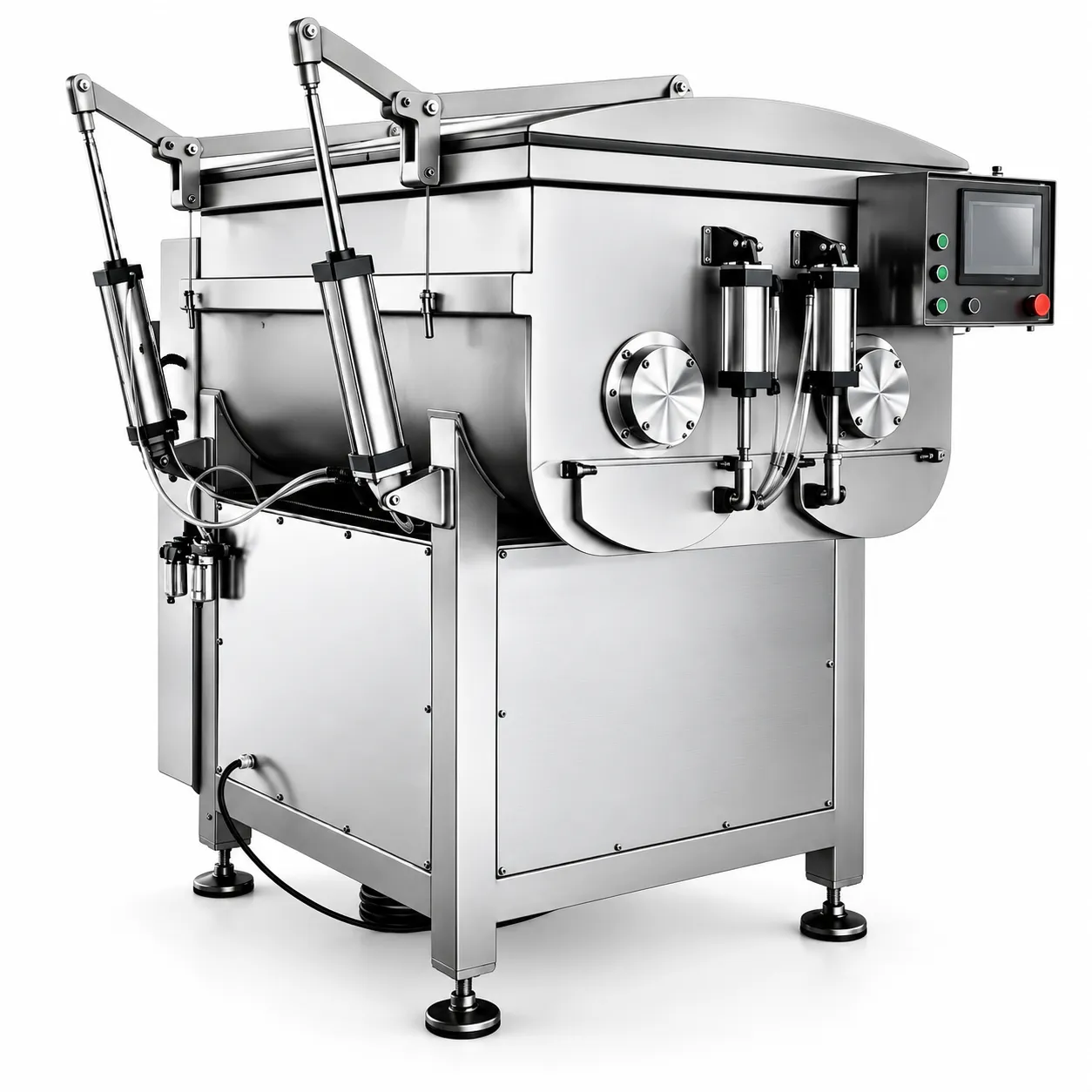
JB-300 — 300 L hopper, dual-shaft spiral paddle, chain drive
Dual-Shaft Spiral Paddle Blades: Mixing Geometry and Efficiency
The JB-300’s dual-shaft elliptical spiral paddle system is the key engineering feature that distinguishes it from simpler single-shaft or vane-type mixers. Each shaft carries a set of elliptical spiral paddles that overlap with the opposite shaft’s paddles without contact, creating an interlocking mixing geometry. As the shafts rotate at 84 r/min (or 42 r/min in the reduced-speed setting), the paddles simultaneously push material radially outward and drive axial flow from one end of the hopper to the other.
This combined radial-plus-axial flow pattern achieves thorough mixing from the geometric centre of the hopper to the hopper walls and from end to end within approximately 4–6 minutes for a typical sausage farce or seasoned chunk batch. Single-shaft mixers achieve adequate blending of low-viscosity slurries but struggle with the plug-flow tendency of high-viscosity or chunked meat loads — the dual-shaft design eliminates this limitation. The 42 r/min low-speed option is used for fragile chunk products where surface integrity must be preserved during seasoning distribution.
Vacuum Mixing and Meat Quality: The Science Behind the Process
When meat, fat, water, salt, and spices are mixed in an open vessel, mechanical action entrains atmospheric oxygen into the product mass. Oxygen accelerates lipid oxidation in the fat phase, producing rancid off-flavours during refrigerated shelf life, and drives myoglobin oxidation in the lean phase, turning the meat grey-brown rather than the commercially acceptable bright red. In emulsified products, entrained air creates bubbles in the farce that survive into the cooked sausage as visible voids, reducing perceived quality and, in weight-sold products, effective yield.
The JB-300’s vacuum system evacuates the headspace above the product mass before and during mixing, preventing oxygen entrainment at the source. Under vacuum, protein extraction is also enhanced: reduced pressure encourages myofibrillar proteins to migrate to the meat surface, improving inter-particle binding and therefore cooking yield. For whole-muscle products mixed with brine after a brine injection step, vacuum mixing accelerates brine distribution throughout the muscle mass, reducing the equalisation time required before the product moves to the filler or smoker.
- Vacuum mixing: prevents oxygen entrainment; preserves meat colour in refrigerated shelf life
- Protein extraction: vacuum enhances myofibrillar protein migration to surface — better binding
- Cooking yield: improved protein matrix translates to measurable yield gain in cooked products
- Batch time: typical sausage farce uniformity specification reached in 4–6 minutes at 84 r/min
- Chunk mixing: 42 r/min low speed for marinated chunk products; preserves piece integrity
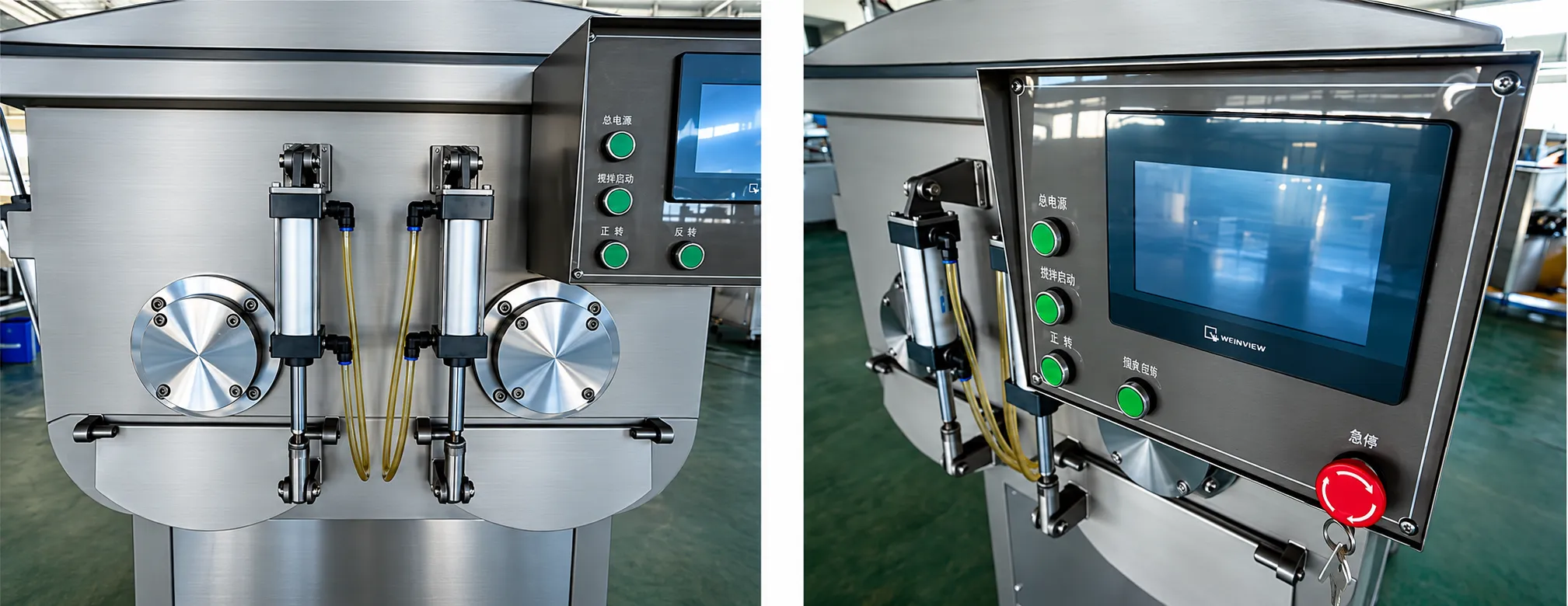
Elliptical spiral paddle blades — dual-shaft overlap geometry
Processing Applications and Capacity Planning
The JB-300 handles sausage farce mixing (ground meat with salt, phosphates, water, spices, and nitrite), whole-muscle marinating (pork shoulder, chicken thigh, beef trim), seasoned chunk mixing for kebab and gyros production, and fish-paste or surimi blending. Its 300-litre capacity accommodates batches from around 100 kg of loaded product (at 35% fill) to approximately 240 kg at full load, depending on product density and the volume of added water or brine. Running two to four batches per hour at typical mixing times, the JB-300 supports daily output volumes of 600–1,500 kg of mixed product across a single shift.
For sausage producers using a sequential process — grind, mix, fill — the JB-300 pairs directly upstream of a vacuum sausage filler. The mixed farce can be discharged from the JB-300’s hopper directly into the filler hopper by tipping the mixer body, avoiding the need for an intermediate transfer vessel. For a complete view of mixing and tumbling options, see our Mixing & Tumbling category page.
Chain Drive Reliability and Maintenance Access
The JB-300 uses chain drive transmission to transfer power from the motor to the paddle shafts. Chain drive is selected over belt drive for this application because it maintains a fixed transmission ratio under the high-torque load conditions that occur when the mixer starts with a full hopper of cold, stiff meat product. Belt drives are prone to slip under these conditions; chain drive eliminates slip, providing stable, predictable shaft speed throughout the mixing cycle regardless of load variation.
The chain drive and bearings are located outside the product zone, accessible for lubrication and inspection without opening the product hopper. Routine maintenance can therefore be performed without product contamination risk. The open-lid hopper design allows the interior, paddles, and shaft seals to be cleaned thoroughly between product runs. The SUS304 stainless interior resists the corrosive effect of high-salt brine and acid marinades in daily commercial production environments.
Installation Requirements and Site Considerations
The JB-300’s compact dimensions of 1,400 × 900 × 1,400 mm and 400 kg weight make it one of the most installation-flexible vacuum mixers in the market segment. Standard single-phase or three-phase 380V power supply is required for the 2.4 kW installed load. The machine requires a floor drain within reach of the discharge outlet and access to a compressed air or vacuum source if the site vacuum system is not self-contained. The hopper lid opens upward on a counterbalanced hinge, requiring a minimum ceiling clearance of approximately 2,200 mm above the machine body for comfortable operation.
For processing rooms with limited headroom, the discharge and cleaning sequence can be managed with the lid at half-open position if the product is fully discharged before cleaning. The machine body can be tilted for complete discharge of viscous products; a stainless-steel drain port at the hopper base is provided for liquid brine or wash water removal. Full installation documentation including utility connection diagrams is provided with each machine.
The JB-300 is available with an optional vacuum gauge and digital timer to support recipe documentation and repeatability. Contact us for configuration options before ordering.
Comparing the JB-300 with Open Batch Mixers for Your Application
Open-batch paddle mixers at the 300-litre scale are typically lower in capital cost than vacuum models and require no vacuum pump maintenance. For products that do not require shelf-life extension, where the processing environment is low in oxygen anyway, or where the product will be cooked within hours of mixing, open mixing can be adequate. The JB-300’s vacuum capability adds measurable value specifically for products where meat colour in retail-pack chilled shelf life is commercially important, for products with shelf-life targets that are difficult to achieve with open mixing, and for cured products where nitrite colour development is a quality specification. For these applications, the payback period for the vacuum premium over a comparable open mixer can be short when measured against reject rates, customer complaint costs, and the value of extended shelf life.
The JB-300 is also suited to processors who are scaling into vacuum mixing for the first time: its compact footprint and modest utility requirements make it easier to integrate into an existing plant layout than a larger unit, allowing teams to develop vacuum mixing expertise and documented recipes before committing to a larger installation. Our sales team can assist with a product-by-product assessment of which items in your current range would benefit most from vacuum mixing at the JB-300 scale. Contact us to begin that conversation.
سوالات متداول
What is the difference between a vacuum mixer and a bowl cutter?
A bowl cutter emulsifies meat by high-speed chopping — it breaks down muscle tissue and fat into a smooth farce for sausage-type products. A vacuum mixer like the JB-300 blends whole-muscle pieces, chunks, or ground meat with seasonings and brine without disrupting the meat’s structure, preserving a chunky or sliced texture in the finished product. The two machines serve different product types and are often used together in plants producing both emulsified and whole-muscle items.
Why does vacuum mixing improve marinade uptake and binding?
Under vacuum, air is evacuated from the spaces between meat fibres, allowing marinade liquid and salt to penetrate more deeply into the muscle. Repeated gentle mixing under vacuum also works the proteins on the cut surfaces, releasing myosin which forms the protein gel that binds pieces together after cooking. The result is better marinade distribution, improved colour uptake, and stronger inter-piece binding in formed or restructured products.
Can the JB-300 process brine-injected whole-muscle cuts?
Yes. The JB-300 is the standard follow-on step after brine injection in whole-muscle processing. Injected product is loaded into the mixer drum, where the controlled tumbling action distributes the injected brine evenly throughout the muscle, works the surface proteins, and adds any surface seasoning uniformly. Together, injection and vacuum mixing achieve distribution quality that neither process achieves alone.
What product types is the JB-300 best suited to?
The JB-300 is well suited to: marinated chicken portions, seasoned pork products, formed poultry rolls, deli ham, whole-muscle salami, and brine-marinated fish. At 300-litre drum capacity and up to 120 kg per batch, it is sized for small- to mid-scale whole-muscle processing operations running one or two shifts per day.
How is the vacuum system maintained and serviced?
The vacuum pump requires periodic oil checks and oil changes per the pump manufacturer’s schedule, typically every 500–1,000 hours. The drum vacuum port and seal should be inspected for wear at each cleaning cycle. Replacement seals and gaskets are included in the quick-wear spare parts kit. For spare-parts and technical support enquiries, contact our after-sales team.
سفارش و لجستیک
سفارش و لجستیک
آماده سفارش هستید؟
Standard lead time is 30–45 working days from confirmed purchase order and deposit, inclusive of an 8-hour pre-shipment functional test. Default shipping terms are FOB Tianjin; CIF, EXW, and DAP are negotiable. Each unit ships with a CE certificate, English-language operation manual, electrical schematics, and a quick-wear spare parts kit. Payment: T/T 30% deposit, 70% before shipment. L/C accepted on request.
کشورهاي: No fixed piece-count minimum for complete machines. Orders are evaluated by configuration and order value. New buyers can arrange 1–5 unit sample orders. Multi-model combinations are welcomed.
درخواست قیمت
Our team responds within 1 business day. Include your target product type, required capacity, and destination port.
Ordering and Lead Time
The JB-300 ships from Tianjin, China, in a wooden export crate with foam and moisture-barrier protection. Typical ocean transit times are 18–35 days to European and Middle Eastern ports, and 25–45 days to US and South American ports, depending on routing. Production lead time is 30–45 working days. Each machine is inspected and photographed by our factory QC before packing. The shipment includes a full spare-parts kit for quick-wear components, reducing the risk of extended downtime in the event of a routine wear-part replacement in the first year of operation. For a complete landed-cost estimate, contact our export sales team.
Ready to specify? Enquire about the JB-300 vacuum meat mixer — our engineering team responds within one business day.
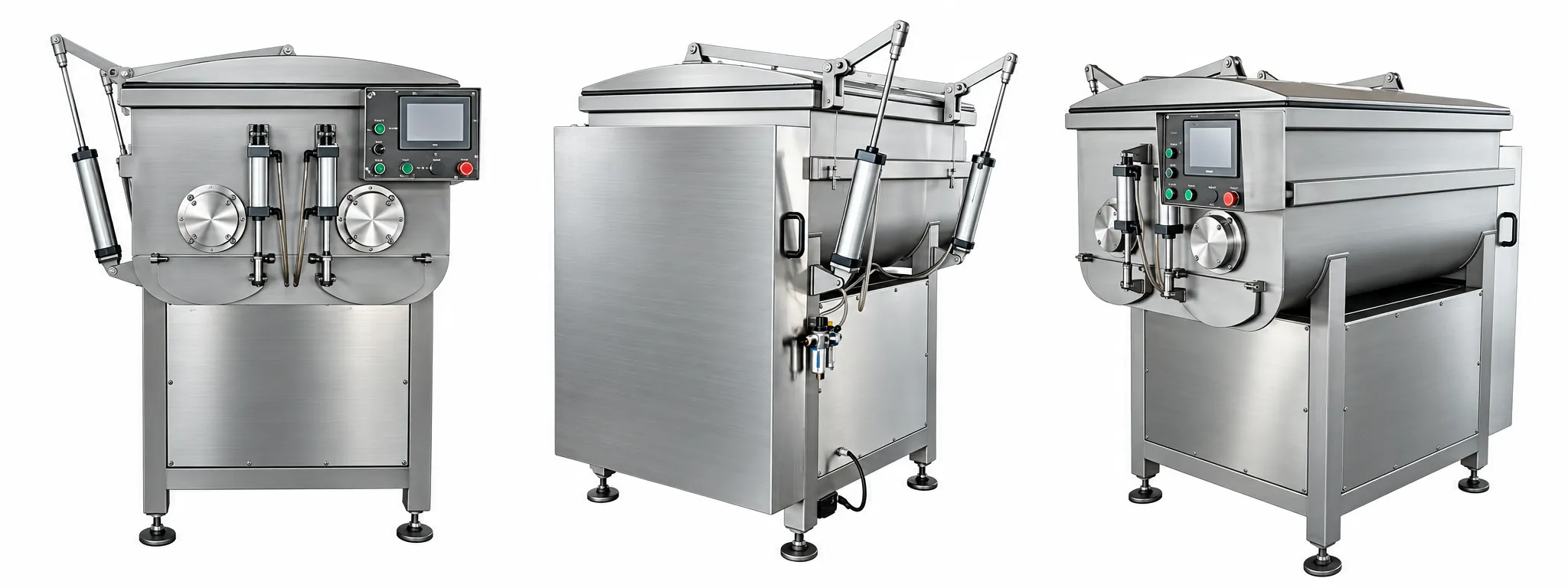
JB-300 dimensional reference — 1,400 × 900 × 1,400 mm
About the manufacturer
With more than two decades of manufacturing experience, the manufacturer has built a reputation as a reliable OEM and direct-supply partner for meat processors in Europe, the Middle East, Southeast Asia, and the Americas. The company’s 5,000 m² Hebei Province facility operates under strict in-house quality management: every machine undergoes full functional testing before shipment, and a dedicated after-sales team provides remote technical support, spare-parts supply, and on-site installation assistance for export customers. For purchasing, technical, and logistics questions, contact our international sales team or email [email protected].