Beschrijving
| Technische specificaties | |
|---|---|
| Model | ZB-125 |
| Production Capacity | 70 kg / batch |
| Bowl Volume | 125 L |
| Stroom | 35 kW |
| Chopper Quantity | 6 |
| Chopper Speed | 4,500 r/min |
| Bowl Speed (Worm Speed) | 11 / 17 rpm |
| Discharging Device Speed | 83 r/min (motorised) |
| Dimension (L × W × H) | 2,205 × 1,420 × 1,609 mm |
| Machinegewicht | 1,800 kg |
| Control Panel | IP65-rated waterproof |
| Bouw | SUS304 stainless steel, CNC-machined core components |
| Bearings / Motor | Imported European standard |
| Garantie | 1 year whole-machine |
125L Industrial Bowl Cutter Machine — ZB-125
The ZB-125 is a mid-volume industrial bowl cutter built for meat processors that need consistent, high-quality emulsification at 70 kg-per-batch throughput. Running at 4,500 r/min chopper speed — 500 r/min faster than the ZB-80 — and a two-speed bowl rotation of 11 or 17 rpm, the ZB-125 handles the full spectrum of emulsified sausage products, from fine frankfurter farce to coarser country-style blends. Its 35 kW main drive delivers the torque needed to process partially frozen trim without blade stall, maintaining consistent cut quality across the full batch cycle.
The CNC-precision-machined mechanical components set the ZB-125 apart at its price point: knife-to-bowl clearance is held to tight tolerance across the production life of the machine, ensuring that emulsification quality does not degrade as operating hours accumulate. The motorised discharging device at 83 r/min allows rapid, clean bowl emptying between batches, reducing cycle-time loss compared with manual discharge at larger batch sizes.
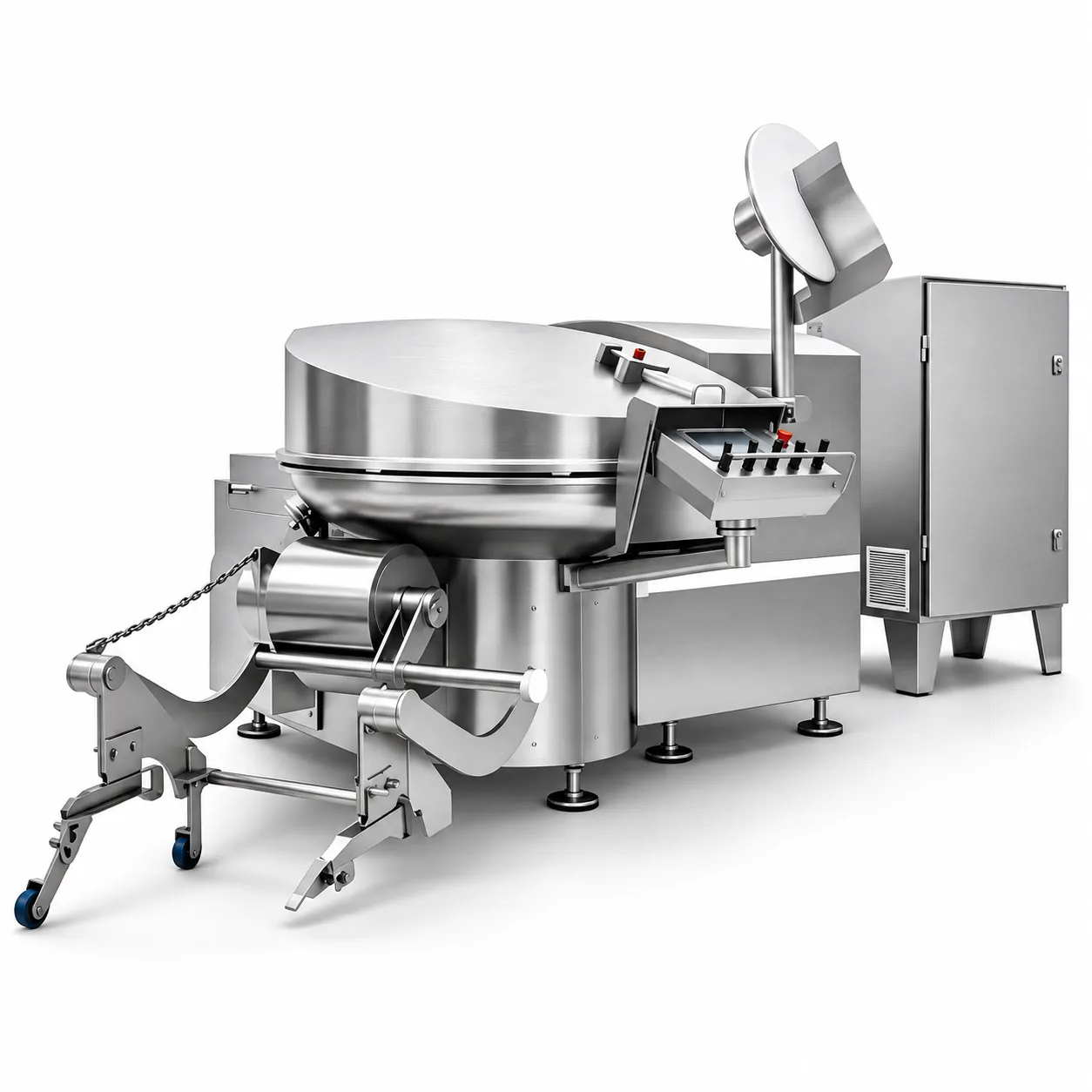
ZB-125 — 125 L bowl, 4,500 r/min, 70 kg/batch, motorised discharge
CNC-Machined Components and Emulsification Precision
Emulsification quality in a bowl cutter depends on three interacting variables: blade speed, knife-to-bowl clearance, and bowl rotation speed. Of these, knife-to-bowl clearance is the hardest to control over the machine’s lifetime in a machine built to lower tolerances. In the ZB-125, CNC machining of the bowl, blade carrier, and blade mounting surfaces ensures that clearance is set to the designed specification at assembly and remains within that specification as the machine wears in. This precision has direct product consequences: tighter clearance means more of the material passes through the high-shear zone between blade edge and bowl wall per revolution, producing finer particle size and more complete fat emulsification with fewer passes.
The imported European-standard bearings on the main chopper shaft and bowl drive are rated for the continuous radial loads generated at 4,500 r/min under typical production loading. The dual-speed bowl drive (11/17 rpm) gives the operator independent control over material turnover rate: 11 rpm for initial loading and coarse-cut phases, stepping to 17 rpm for final fine emulsification to maximise throughput without over-running the material.
Applications: Emulsified Sausage and Deli Meat Products
The ZB-125 is the recommended choice for mid-volume sausage processing operations producing from a few hundred to several thousand kilograms of emulsified product per day across one or two shifts. Primary product applications include frankfurters, Vienna sausages, bologna, mortadella (plain and with visible fat pieces added late in the cut cycle), liver sausage, blood sausage, pté-style meat paste for both fresh and cooked-and-chilled retail formats.
The machine also handles non-meat applications including fish paste, surimi-based products, and vegetable-protein-extended sausage formulations. For processors producing a wide range of emulsification levels, the two-speed bowl combined with the single chopper speed of 4,500 r/min provides sufficient recipe variation through differences in processing time and initial material temperature. Prior grinding through a frozen meat grinder is recommended for material containing bone-in trim or very hard frozen blocks.
- Chopper speed: 4,500 r/min (single speed, full emulsification power)
- Bowl speed: 11 or 17 rpm (dual speed, independent of chopper)
- Motorised discharge: 83 r/min — fast, clean bowl emptying
- Bowl capacity: 125 L (recommended fill: 60–90 L per batch)
- Output: up to 70 kg emulsified farce per batch
- Construction: CNC-machined SUS304 throughout; European bearings and motor
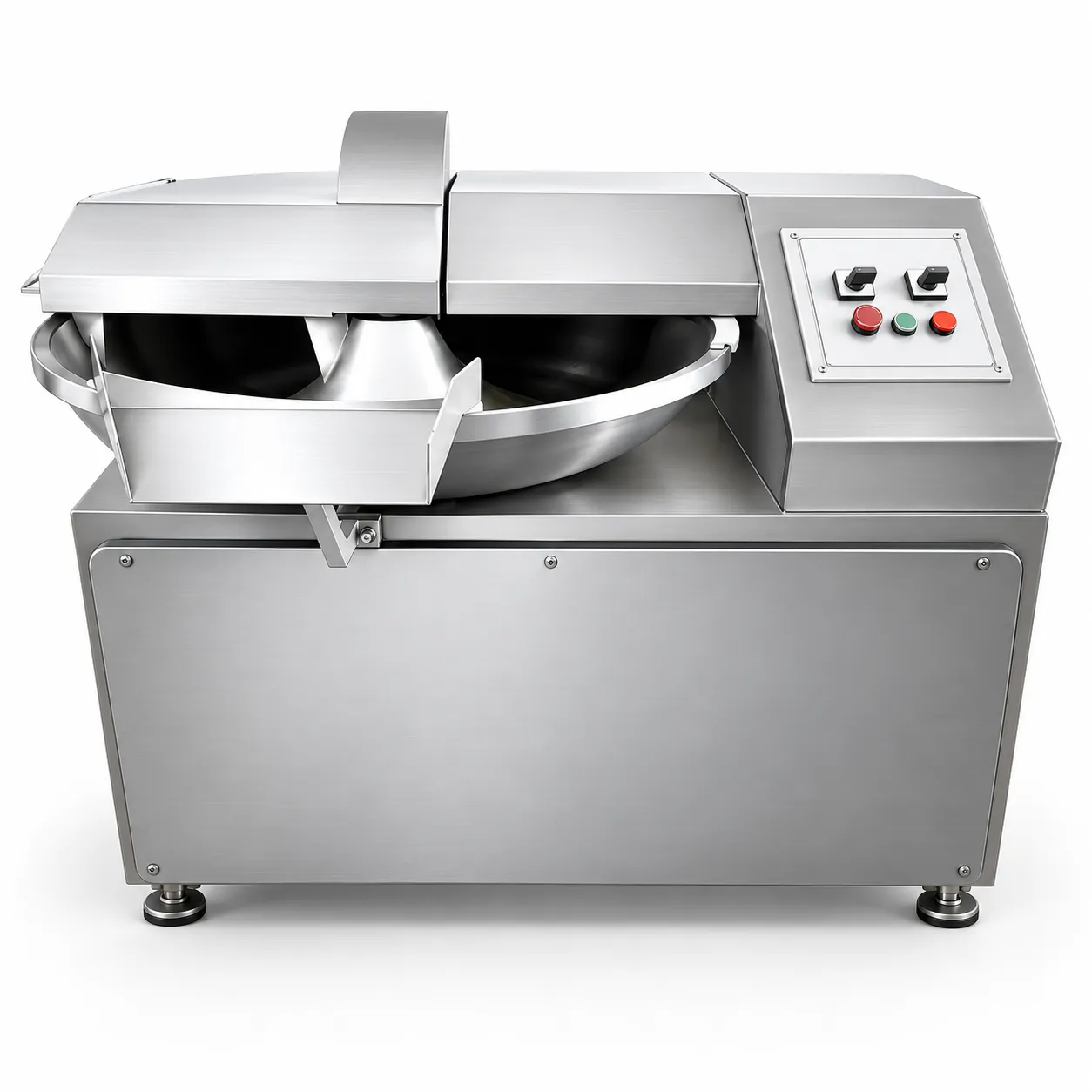
ZB-125 in production — IP65 panel, 35 kW main drive
Knife Configuration and the Science of Fine Emulsification
The ZB-125 is equipped with six chopper knives arranged symmetrically on the blade carrier. Six-knife configuration is the industry standard for fine-emulsion products: it balances the number of cutting events per revolution (which drives emulsification rate) against the inter-blade spacing (which prevents overheating by allowing material to circulate between blades). At 4,500 r/min, the ZB-125 delivers approximately 27,000 cutting events per minute in the bowl — sufficient to produce frankfurter-quality emulsion from standard chilled pork trim in a typical 4–6 minute cut cycle.
Fine emulsification is a protein chemistry process: myofibrillar proteins released from cut muscle cells form a matrix that surrounds and stabilises dispersed fat droplets. The completeness of this matrix, and therefore the cooking stability of the emulsion, depends directly on the fineness and uniformity of the cut. Blades that are sharp, clearance that is tight, and a bowl speed that keeps fresh material continuously cycling through the cutting zone are the three mechanical requirements the ZB-125 is designed to meet from day one of production.
Production Line Integration and Workflow
The ZB-125 integrates into emulsified-sausage production lines as the core emulsification step between meat grinding and filling. Processed farce is discharged through the 83 r/min motorised device directly into the hopper of a vacuum sausage filling machine, maintaining the cold-chain integrity of the emulsion between the bowl and the casing. Plants that also produce whole-muscle products can position the ZB-125 in parallel with a brine injection machine and vacuum tumbler on an adjacent line, sharing downstream filling and clipping equipment across both product types.
For a complete overview of mixing, tumbling, and emulsification equipment options, visit our Mixing & Tumbling product category. Our engineering team can assist with equipment selection, line layout, and throughput calculations for your specific product range.
Operator Controls, Safety, and Maintenance Planning
The ZB-125’s IP65-rated waterproof control panel provides all machine functions from a single operator station: chopper speed selection (two stages plus stop), bowl speed selection (11/17 rpm), lid interlock status, and discharge actuator control. The lid interlock prevents the chopper from running while the bowl lid is open, eliminating the primary mechanical hazard in bowl cutter operation. The discharge device is interlocked to prevent simultaneous chopper and discharge operation.
Planned maintenance intervals for the ZB-125 are: blade inspection and re-sharpening or replacement every 500–800 operating hours depending on product hardness; bearing lubrication per the component supplier’s schedule (typically every 1,000–2,000 hours); chain tension check (if applicable to drive configuration) monthly. The quick-wear spare parts kit included with the machine covers consumable components for the first year of normal production operation, minimising procurement lead time for routine service items.
Technical documentation — electrical schematics, foundation drawings, spare-parts list, and operator manual — is included with every ZB-125. Contact us for a sample datasheet before purchase.
Batch Cycle Planning and Daily Output Estimation
For production managers sizing a ZB-125 installation, the key planning parameter is the batch cycle time: the elapsed time from loading the bowl with chilled trim to discharging the finished emulsion into the filler hopper. For a typical frankfurter farce at a four-minute cut cycle, total cycle time including loading and discharging via the motorised device is approximately 6–8 minutes per batch. At 70 kg per batch, a ZB-125 operating over an eight-hour shift can produce approximately 520–700 kg of emulsified farce, depending on product type, recipe complexity, and changeover frequency. For plants producing two or more product types per shift, the blade clean-down time between allergen groups should be factored into shift capacity calculations. The ZB-125’s lid-interlock design allows the bowl and lid to be cleaned in place using washdown equipment without requiring full strip-down of the blade assembly for single-allergen-group rotations.
The motorised 83 r/min discharging device is a productivity-critical feature at the 70 kg batch size: manual discharge of 70 kg of emulsified farce from a 125-litre bowl is physically demanding and slow, adding 2–4 minutes to each batch cycle that the motorised device eliminates. Over a full production shift, this time saving translates directly into additional batches and additional output from the same installed equipment. The discharging device is interlocked with the chopper drive, preventing concurrent operation of the blades and the discharge mechanism as a standard safety measure.
Veelgestelde vragen
What throughput should I plan for across a full production shift?
At a typical 4-minute cut cycle for frankfurter farce, total batch cycle time including loading and motorised discharge is approximately 6–8 minutes. At 70 kg per batch, an eight-hour shift yields approximately 520–700 kg of emulsified farce. Allow additional time for inter-allergen changeover cleaning when running multiple product types per shift.
Why does knife-to-bowl clearance affect emulsification quality?
Tighter clearance means more material passes through the high-shear zone between the blade edge and the bowl wall per revolution, producing finer particle size and more complete fat emulsification with fewer passes. CNC machining of the bowl and blade carrier in the ZB-125 ensures this clearance is set to design specification at assembly and remains within specification as the machine wears in.
Can the ZB-125 process partially frozen material directly?
Yes. The 35 kW main drive delivers the torque needed to process partially frozen trim without blade stall. For best results, material should be at −2 to 0 °C at the start of the batch for emulsified products. Fully frozen blocks should be pre-ground in a meat grinder before loading the bowl.
How does the motorised discharge device reduce cycle time?
Manual discharge of 70 kg of emulsified farce from a 125-litre bowl is physically demanding and adds 2–4 minutes to each batch cycle. The 83 r/min motorised discharging device eliminates this time, increasing the number of batches achievable per shift from the same installed equipment. The device is interlocked with the chopper drive as a standard safety measure.
What documentation is supplied with the ZB-125?
Each machine ships with: electrical schematics, foundation and utility connection drawings, operator manual (English), CE certificate, and a quick-wear spare parts kit. For a sample datasheet before purchase, contact our technical sales team.
Bestelling & Logistiek
Bestelling & Logistiek
Klaar om te bestellen?
Standard lead time is 30–45 working days from confirmed purchase order and deposit, inclusive of an 8-hour pre-shipment functional test. Default shipping terms are FOB Tianjin; CIF, EXW, and DAP are negotiable. Each unit ships with a CE certificate, English-language operation manual, electrical schematics, and a quick-wear spare parts kit. Payment: T/T 30% deposit, 70% before shipment. L/C accepted on request.
Minimale bestelhoeveelheid (MOQ): No fixed piece-count minimum for complete machines. Orders are evaluated by configuration and order value. New buyers can arrange 1–5 unit sample orders. Multi-model combinations are welcomed.
Vraag een offerte aan
Our team responds within 1 business day. Include your target product type, required capacity, and destination port.
Shipping and Ordering Information
Standard lead time for the ZB-125 is 30–45 working days from receipt of confirmed purchase order and deposit. The machine is packed in a heavy-gauge wooden export crate with full foam-block internal protection, suitable for container shipping. Port of loading: Tianjin. Incoterms: FOB Tianjin as standard; CIF and DDP quotations available on request for qualifying destinations. All machines are subject to pre-shipment factory inspection by our factory quality control before packaging. Third-party inspection (SGS, BV, CCIC) can be arranged on request. Contact our team at our enquiry page for shipping terms, lead time confirmation, and an FOB quotation.
Ready to specify? Request a ZB-125 quotation from our sales team — our engineering team responds within one business day.
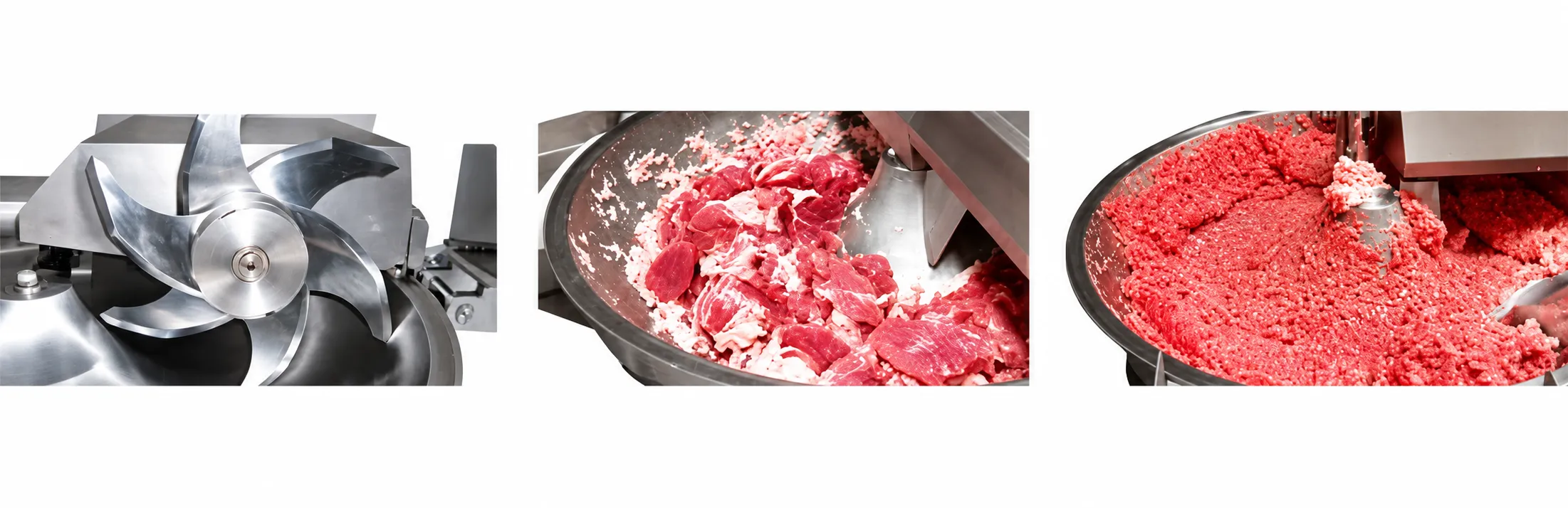
Precision-ground six-blade chopper and polished SUS304 bowl interior
About the manufacturer
Founded in 1999, the manufacturer occupies a 5,000 m² manufacturing campus in Hebei Province. More than 100 engineers, machinists, and after-sales technicians support a product range that covers the full cooked-meat and sausage processing workflow — from brine injection and tumbling through filling, clipping, and smoking. Machines are built to food-grade SUS304 stainless steel throughout, with IP65-rated control panels and CE-compliant electrical systems. Reach our team to request a quotation, technical datasheet, or factory audit schedule.